
The question to settle first
A spring helps counterbalance the door. When it fails, the opener may strain or the door may become dangerously heavy. A visible spring gap, sudden bang or uneven travel deserves a controlled inspection rather than another attempt with the remote.
Begin with garage door spring repair when discussing this issue. This guide helps prepare that conversation.
Recognize the warning pattern
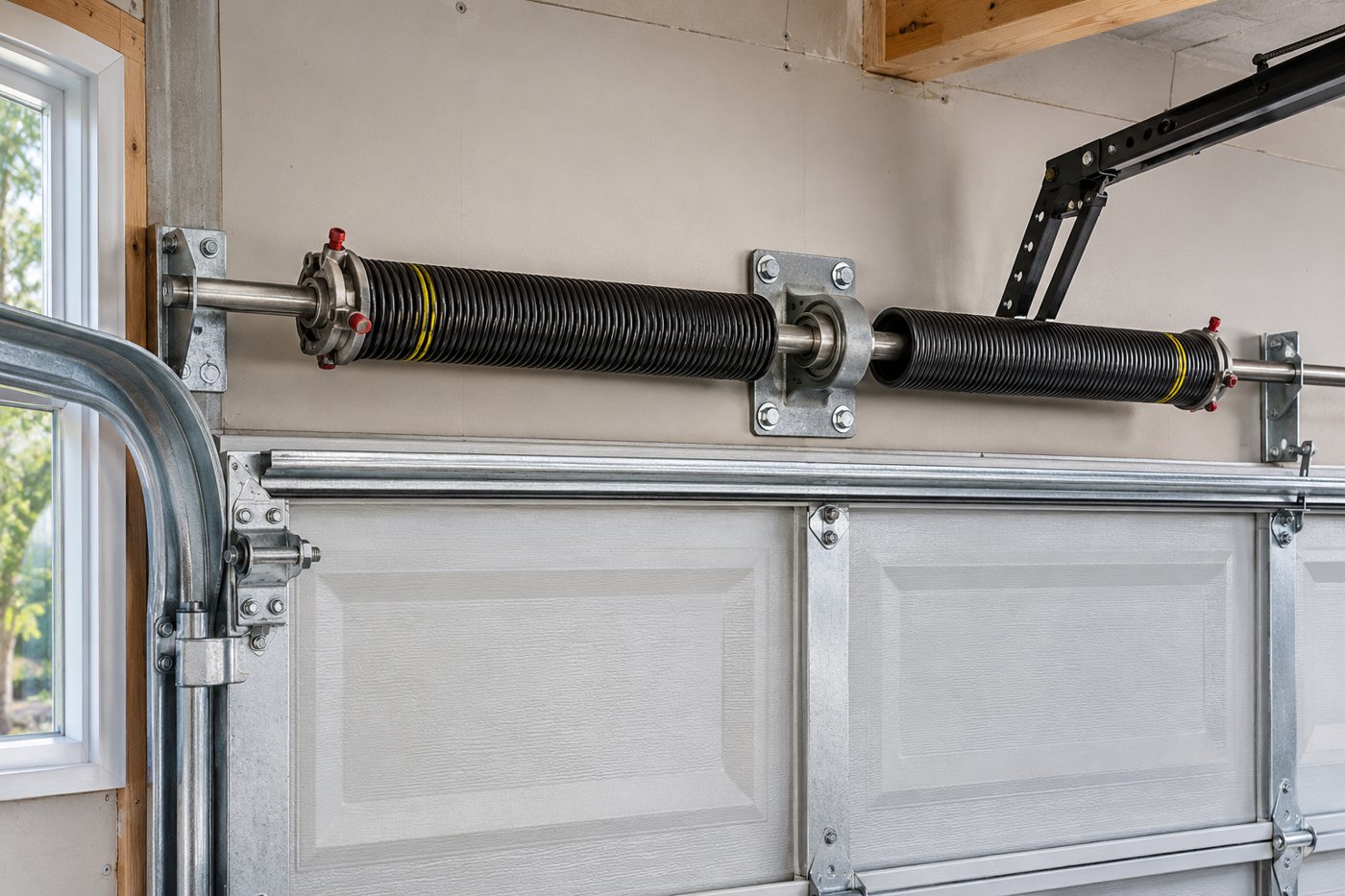
A torsion spring is commonly mounted above the opening around a shaft. A separation in the coil can be visible when it breaks. Other systems use extension springs alongside the tracks. Layouts vary, and an unfamiliar assembly should not be touched simply to identify it.
A bang alone does not prove a spring failed. Report what happened immediately afterward: did the door stop moving, become uneven or leave a loose cable? Keep observations separate from diagnosis so the technician can assess the full lifting system.
What to do while waiting
Stop cycling the opener and keep the opening clear. Do not lift a heavy door alone, wind a spring, loosen a bottom bracket or pull on a cable. Do not stand beneath a partly raised door. If the system is visibly unstable, leave it alone and prevent others from approaching.
Explain whether the door is fully closed or suspended. A closed door and an open door need different control of the load. Do not pull an emergency release under a raised door with suspected spring damage: it may drop rapidly.
Why matching matters
| Information | Reason it matters |
|---|---|
| Actual door weight | Counterbalance must match the load |
| Door height and travel | Changes the lifting arrangement |
| Spring configuration | Torsion and extension systems differ |
| Drum, cable and shaft condition | Other damage can affect balance |
| Usage pattern | Relevant to specification discussion |
The existing spring is not always proof of the correct specification. An earlier replacement could have been unsuitable, or panels may have changed. A professional assessment should explain the selected arrangement and the checks performed after fitting.
Ask about connected components
The cable drums, bearings, shaft and anchor hardware work with the springs. A slack cable may be a result of another failure, not a part to push back into place. Ask whether associated wear or damage has been checked and whether paired springs are being evaluated together.
A stronger opener is not the remedy for an unbalanced door. The door needs to be assessed mechanically before an operator is reconnected or adjusted. Increasing force can hide resistance and create additional hazards.
Return to use deliberately
The handover should explain the work, balance checks and controlled full travel. Where an opener is fitted, its safety functions need checking under the manufacturer instructions. Keep the repair information and report any new uneven movement promptly.
Do not test a visibly damaged door yourself. Routine owner checks apply to an otherwise sound operating system; suspected spring failure belongs with trained service personnel. Keep the owner manual for later maintenance guidance once the system is safe.
Applying this in Phoenix
In Phoenix and the supported surrounding ZIPs, note whether the opening faces strong afternoon sun and whether dust is present near the sensor path. Pinal-area coverage follows the exact ZIP list, so include the postal location at the beginning of the call.
Check the coverage directory and related service options. For a sudden heavy door, use the spring failure guide; for control symptoms, read sensor diagnosis.
Technical reading
DASMA garage-door system safety and CPSC opener safety guidance. Read the model-specific manual before any owner check.
A useful next step
Call with the door position, ZIP and observed symptom. Calls and repair requests are accepted 24/7; local scope and scheduling are confirmed by phone. Do not operate a visibly unstable door while gathering information.